For novelists with a draft and a mess

Novel writing software that keeps your draft and story guide in sync.

Your draft and your story guide are the same object seen from two sides. Novelbound keeps them in sync - so Chapter 14 never contradicts Chapter 3 again.

Free for 7 days, then $12.99/month · cancel any time · card required, nothing charged until day 8

You know this feeling.

Mid-draft, and losing the thread.

Contradiction
Chapter 14 contradicts something set up in Chapter 3 - and a reader finds it first.
Open thread
A mystery planted beautifully in Act One is never paid off, because you forgot it exists.
The fix
Novelbound tracks every promise you make the reader - and refuses to let you call the book finished while one is still hanging.
One object, two sides

The draft is the story guide. The story guide is the draft.

Scrivener is manuscript-first and forgets the world. A wiki is reference-first and never touches the prose. Novelbound’s whole job is keeping the two in sync - every character, planted clue and promise, linked to the scene that made it true.

See how the connected story guide works →
Story guide · Mirren Hale
Wants: the house back · Needs: to stop earning it
⚠ “The second car” - set up Ch. 3, never paid off
Appears in 12 scenes · 3 open promises
Jump to the scene that set it up → Ch. 3
Inside Novelbound

This is the actual thing.

Not mockups. Three screens from the running app.

The shelf

Every book you have, and how far in you are.

The spines are drawn to scale: spine width is words written. A book you have barely started is a sliver; one you have lived in for a year is fat on the shelf. Words, chapters and beats covered for each, at a glance.
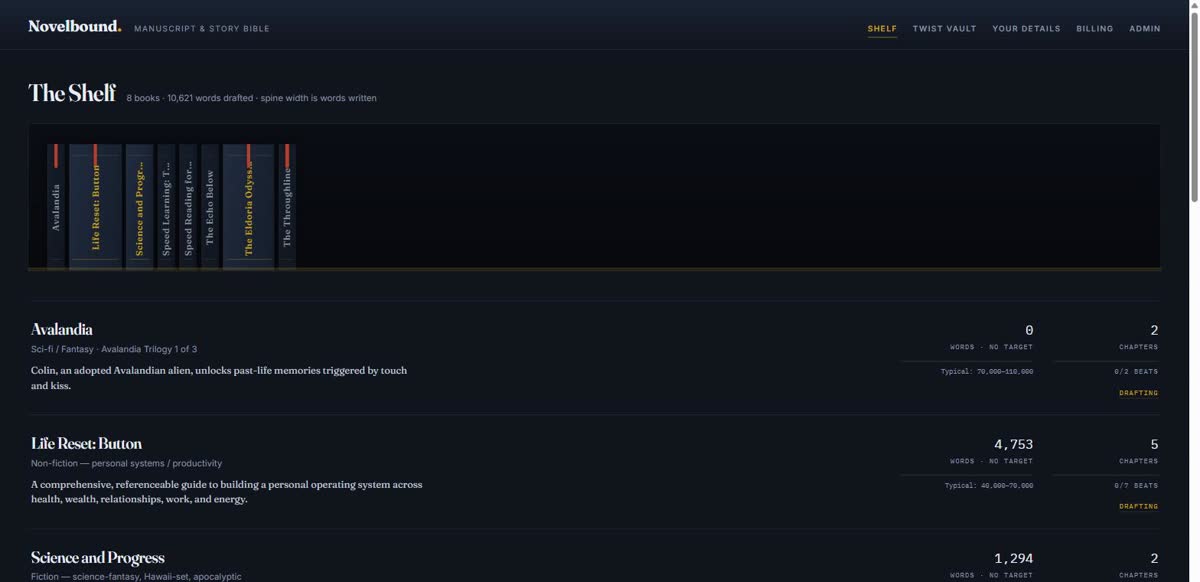
The Novelbound shelf, showing books with spines drawn to scale by word count
Structure

See the shape before the middle sags.

Pick a framework and the beats scaffold themselves. The health bar shows where each beat should fall against where your scenes actually put it, so structural drift is something you notice while writing rather than after a reader tells you.
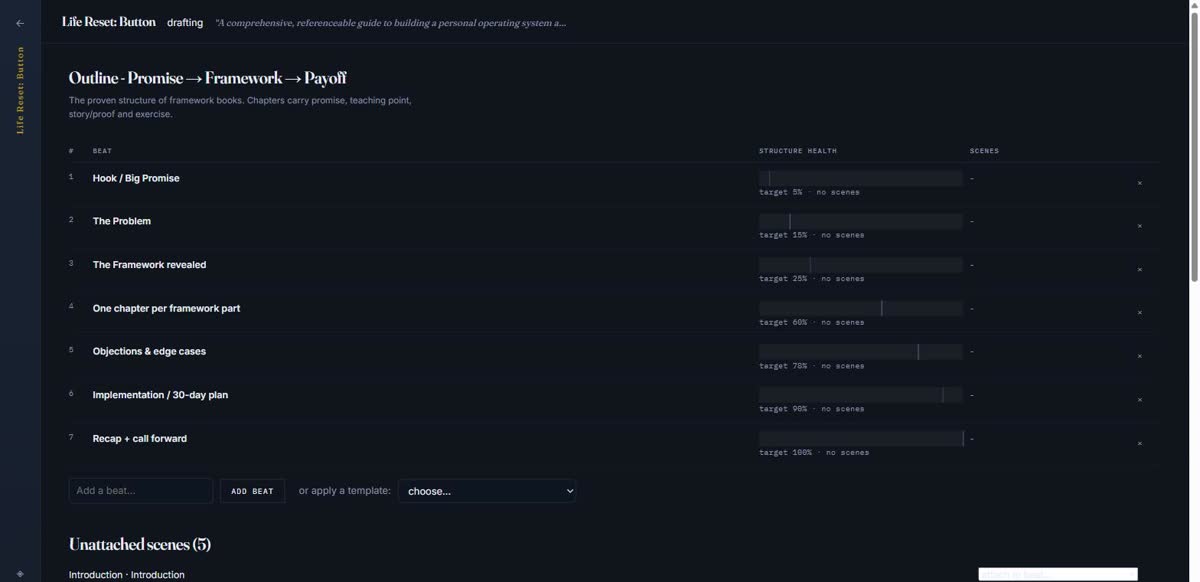
The outline screen showing beats with target positions and a structure health bar
Ready for Amazon

The numbers that get a book rejected, worked out for you.

Trim size, page count, gutter against KDP’s minimum, and your spine width to the thousandth of an inch - all computed from your real manuscript, all moving as you write. Then the two files Amazon actually wants.
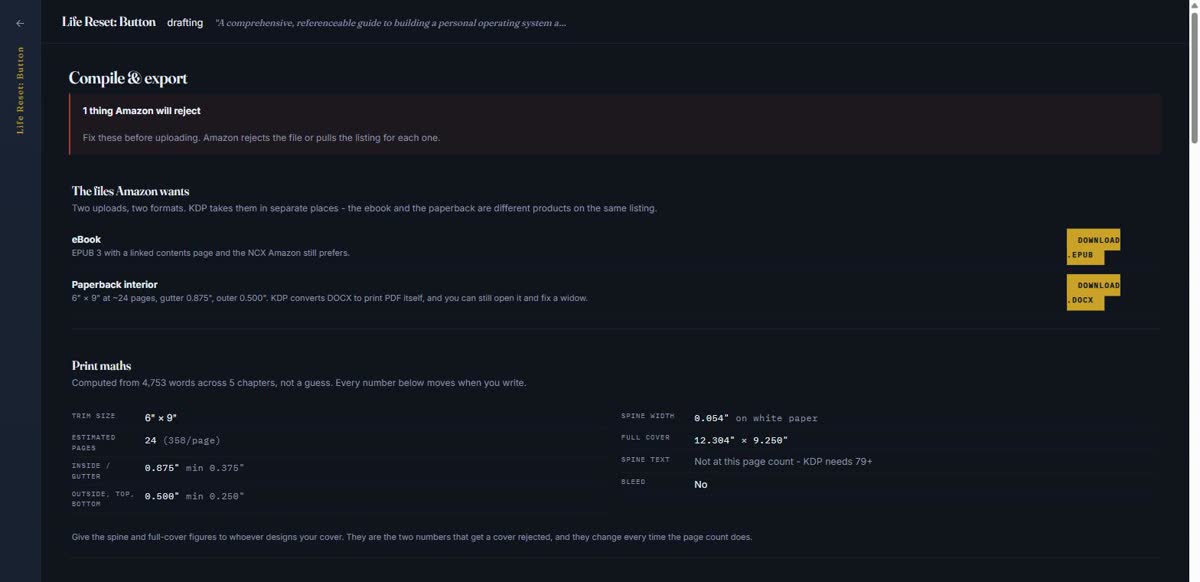
The export screen showing KDP print maths: trim size, page count, gutter, spine width and cover dimensions
Explore the whole workflow

Start with the part of the book that is fighting you.

Practical guides and connected tools for story development, revision, and publishing.

Novel-writing cluster
Outline the shape, track character and plot change, diagnose pacing, and revise the manuscript you actually wrote.
Explore novel writing tools →
KDP publishing cluster
Prepare separate EPUB and print workflows with linked trim, page, gutter, spine, cover, and metadata checks.
Prepare for KDP formatting →
Not just novels

Eleven ways to write a book.

Pick what you’re actually making. A playwright gets acts and scenes, a poet gets sections and poems, a musical gets a song list - not a novel’s vocabulary with the labels swapped.

Novel
A full-length work of fiction
Novella
Short-form fiction, one clean arc
Short story collection
Separate stories under one cover
Non-fiction book
A guide, framework, or argument
Memoir
True story, told with fiction's craft
Poetry collection
Poems arranged into a whole
Children's picture book
Words built around the page turn
Graphic novel / comic
Script in panels and pages
Stage play
For actors, in a room, tonight
Musical
Book, music and lyrics together
Screenplay / teleplay
For the screen, in industry format
The 90-day program

One question a day. Ninety days.

Not a blank page and good luck. Every day asks you one thing, and your answer becomes a real part of the book - a character, a promise, a beat, a scene in your own words.

Days 1–12
Foundation
Twelve days deciding what this actually is. Nothing here is wasted - a book with a vague premise fails in month three, not week one.
Days 13–26
People & world
Two weeks on the people. Plot is what happens; character is why anyone cares that it did.
Days 27–42
Structure
Sixteen days building the skeleton. You'll write the ending before you write the middle, on purpose.
Days 43–70
The draft
Twenty-eight days of writing. The questions get shorter now - the work is the point, not the answers.
Days 71–83
Revision
Thirteen days making it hold together. The app already knows where your threads dangle and where your pacing sags.
Days 84–90
Ready for Amazon
Seven days turning a manuscript into a listing: metadata, description, cover, and a file KDP will accept without complaint.
What you get

Everything between the idea and the listing.

Most tools stop at the draft. This one takes you to a file Amazon will accept.

Promises get paid off

Link a thread to its scenes as setup, develop or payoff. A book with a setup and no payoff cannot be marked finished - the app refuses and names the thread. The mystery-box safety net.

Structure you can see

Save the Cat, Hero’s Journey, Three-Act / 7-Point, Snowflake, and Promise → Framework → Payoff for non-fiction - plus real scaffolds for musicals, plays, screenplays and picture books. A health bar shows where your beats actually fall against where the framework says they should. Drift turns red.

Characters that stay straight

Want versus need, arc type, and every scene they appear in - derived from the manuscript itself, so it can’t quietly go out of date.

Scenes that earn their place

Goal, conflict, outcome, and the value shift from open to close. A scene whose emotional charge doesn’t move gets flagged as flat. It’s a note, not a rule.

Pacing, chapter by chapter

Every chapter carries a word target - yours, derived from your book target, or a publishing convention. A thin chapter and a bloated one are both visible while you draft, not after.

Two timelines

Story order beside page order, because for a mystery-box book those diverge on purpose - and the gap between them is the useful part.

It notices when you stop

Go quiet for a week and Novelbound gets in touch - email, text or a notification, your choice - and reminds you why you said you were writing this.

Amazon-ready, actually

Export a KDP-compliant EPUB 3 and a print interior at a real trim size, with the gutter widened for your page count and the spine width computed to the thousandth of an inch.

The rejection checker

Title and subtitle over 200 characters, a URL in your description, eight keywords where Amazon allows seven, the word “bestselling” where it will get your listing pulled - caught here, before Amazon catches it.

Your cover, briefed properly

A brief builder that already knows your trim size, page count and exact spine width. Generate concepts to find the direction, then hand it to a designer who can finish it.

Built for the odd ones

Musicals get a song list with each number’s dramatic function. Plays track cast size and doubling. Poetry keeps every line break exactly where you put it - the thing every other tool gets wrong.

Your words stay yours

Prose is markdown. Export writes a clean folder of .md files that drops straight into Obsidian. If you leave, your book leaves whole - and it’s backed up nightly while you stay.

Your manuscript is yours alone.

Novelbound has no public side. Nothing you write is published, listed, shared, or shown to another writer - there is no feed to appear in, and no setting you can trip by accident.

No one else can open your book
Every route and every action proves who is asking before it answers, and a test fails the build if a single one forgets. That is enforced in code, not promised in a policy.
That includes us
The owner's admin screen shows counts, dates and billing states - never a title, never a line of your prose. Support questions get answered by asking you, not by reading it.
No AI is trained on your writing
Novelbound has no AI features and sends your work to no model, ours or anyone else's. Your manuscript is not training data, and there is no setting where it becomes any.
Nothing watches the words you write
Optional analytics can measure public pages only after you allow it. It is disabled inside the writing workspace and never receives your manuscript, book notes, or form entries.
It leaves only when you take it
Your prose exports as plain markdown whenever you want it. Publishing to Amazon happens if and when you do it yourself - and never any other way.
Everything, for one writer
$12.99/month

Your first 7 days are free. A card is needed to start and nothing is charged until day 8; cancel before then and you are never charged at all. Billed monthly, cancel any time - then $12.99/month for everyone who joins after September 1, 2026.

$9.99 is the introductory rate for the first 1,000 writers. On September 1, 2026 it becomes $12.99 - but lock in now and yours stays at $9.99 for as long as you keep your subscription.

  • The full 90-day program
  • 6 books on the go at once
  • All eleven literary forms
  • Every structure framework
  • Threads, characters, beats, timelines
  • KDP EPUB + print interior export
  • The Amazon rejection checker
  • Cover brief builder
  • Markdown export, always
  • Nightly backups
  • One book published to Amazon
Start writing
The two limits, up front. You can work on 6 books at a time, and finishing one frees its slot. Your plan covers taking one book to Amazon; each book after that needs a one-off $39.00 publish pass, which never expires. Your writing is never metered and your markdown export never costs extra.

How the 90 days work. Novelbound sells a finished book, not a subscription that quietly renews for four years. Days 1–90 are the program at your subscription price. If you need longer, days 91–180 continue at $14.99/month. After six months an account becomes read-only until you commit to another 6 months up front.

You can always read, and you can always export - at every stage, including a lock, whatever you owe. Nobody loses a manuscript over a card.

No testimonials here yet. Novelbound is new and has no customers, and we’re not going to invent any. These slots belong to the first writers who finish something with it and are willing to say so.

Your draft and your world, in sync.

Bring the draft you have. The mess is the point.

Start writing
Novel Writing Software with a Built-In Story Guide | Novelbound