Start with canon
Record only facts that are true in the draft or decisions you have intentionally made.
The draft is the guide
A useful story guide is not a second book you have to maintain. Novelbound connects the people, places, promises, and timeline facts in your guide to the scenes that establish them, so the reference material grows with the draft instead of drifting away from it.
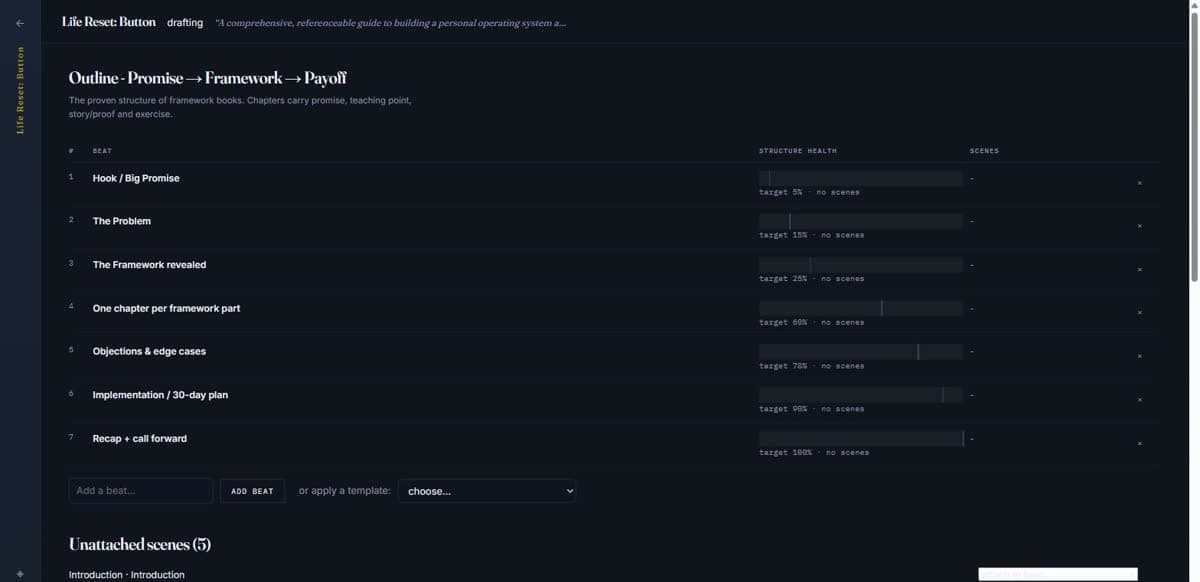
A story guide records the facts a novel must keep consistent: character motives and arcs, location details, rules of the world, chronology, open mysteries, recurring motifs, and the structural promises made to the reader. It should make a fact easy to verify without becoming another place where stale notes accumulate.
Novelbound separates those records by purpose while keeping them inside one book. Character pages show want, need, arc type, voice notes, and scene appearances. Threads record setups, development, and payoffs. The dual timeline keeps story order beside page order for books that reveal events out of sequence.
Static reference documents are accurate on the day they are written. A living draft is not static. When a character enters a scene earlier, a clue moves chapters, or a location changes, the author has to remember to update a separate guide manually.
In Novelbound, the useful relationship is stored along with the fact. A character's appearances are derived from scene links. A thread shows the exact scenes that set it up and pay it off. That makes the guide a way to navigate the manuscript and makes the manuscript evidence for the guide.
During drafting, the guide answers immediate questions without pulling you into a separate wiki. During revision, it becomes an audit trail: which scenes support this arc, where was this promise planted, and whether the chronology still works after scenes moved.
Series writers can share world information across books while keeping each manuscript's viewpoint and scene-level facts distinct. The goal is one dependable source of truth, not a larger pile of notes.
A practical workflow
Record only facts that are true in the draft or decisions you have intentionally made.
Connect people, places, threads, and beats to the manuscript moments that establish them.
Use missing payoffs, sparse appearances, and chronology conflicts as revision prompts.
Share stable series-level details without merging the separate manuscripts.
Questions, answered
A story guide is a structured reference for the facts a story must keep consistent, including characters, setting, chronology, plot threads, world rules, and recurring details.
An outline describes what happens and in what order. A story guide records the people, rules, history, relationships, and promises that must remain consistent while those events unfold.
You can import existing manuscript and story-guide material, then connect the records to scenes. Novelbound is conservative with ambiguous imports so uncertain material can remain notes instead of being treated as canon.
A short, simple novel may need only a light one. A story guide becomes especially useful when a manuscript has multiple viewpoints, a long timeline, mysteries, invented rules, or several rounds of revision.
Your words stay yours
Bring the book you have, including the messy version.
Start writing with Novelbound