Name the story promise
Write a logline and ending direction before choosing a framework.
Plan the shape, not every sentence
Novelbound turns a story framework into a working beat scaffold, then connects each planned beat to real manuscript scenes. You can see where the book follows the intended shape, where it drifts, and where the better choice is to ignore the template.
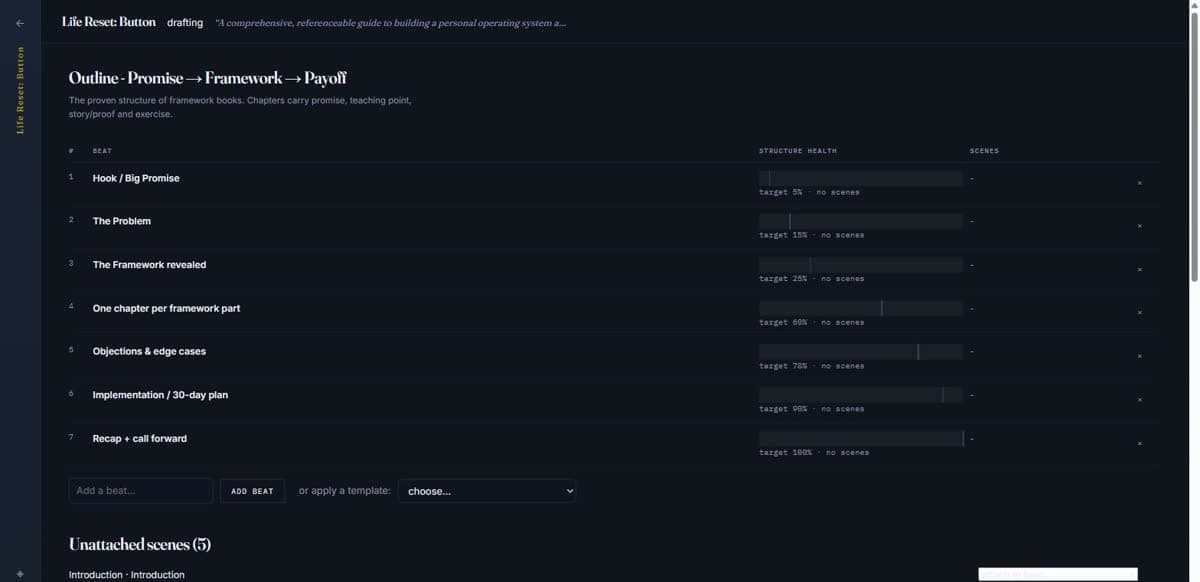
A static beat sheet is a good way to begin and a poor way to understand a changing draft. Once scenes expand, combine, or move, the percentages written in the planning document no longer describe the manuscript.
Novelbound attaches scenes to beats and uses their actual word positions to show the current structure. The comparison is descriptive rather than prescriptive: it identifies a late catalyst or compressed ending so you can decide whether the effect helps the story.
Some writers need a complete scene list before drafting. Others need only an ending, a midpoint, and the next few turns. Novelbound supports both by keeping beats and scenes separate: beats describe structural jobs, while scenes are the manuscript units that may fulfill them.
The Snowflake path is available before drafting for writers who think by expansion: one-sentence logline, paragraph summary, character summaries, synopsis, and scene list. Each stage keeps the earlier promise visible so the story can grow without quietly becoming a different book.
After a draft exists, an outline stops being a prediction and becomes evidence. Missing beats, overloaded scenes, long stretches without a turn, and a rushed final act are easier to discuss when the shape is visible.
Because outline scenes also connect to characters and threads, a structural change can be checked against the rest of the story. Moving a reveal is not only a card moving on a board; it changes who knows what and which promises remain open.
A practical workflow
Write a logline and ending direction before choosing a framework.
Start with a familiar structure or create only the beats your novel needs.
Connect planned and drafted scenes to the structural job each one performs.
Compare target positions with the manuscript and change the outline or the draft intentionally.
Questions, answered
No. You can outline before drafting, discover the story in prose and map it afterward, or do both in short cycles. Novelbound supports a light scaffold as well as a detailed scene plan.
Yes. Custom structures can use your own beats and ordering instead of a named framework.
A beat is a structural function such as catalyst or midpoint. A scene is a unit of the manuscript. One scene can carry a beat, and a beat can sometimes span more than one scene.
It shows how the current manuscript compares with the framework you selected. The author still decides whether a difference is a problem or the right choice for that story.
Your words stay yours
Bring the book you have, including the messy version.
Start writing with Novelbound