Mark the irreversible turns
Find the moments after which the protagonist cannot return to the earlier version of the story.
Structure made visible
Story structure is the pattern of change that carries a reader from the opening promise to the ending. Novelbound shows that pattern through beats, scenes, word position, character arcs, and plot-thread payoffs so structural revision is based on the current draft.
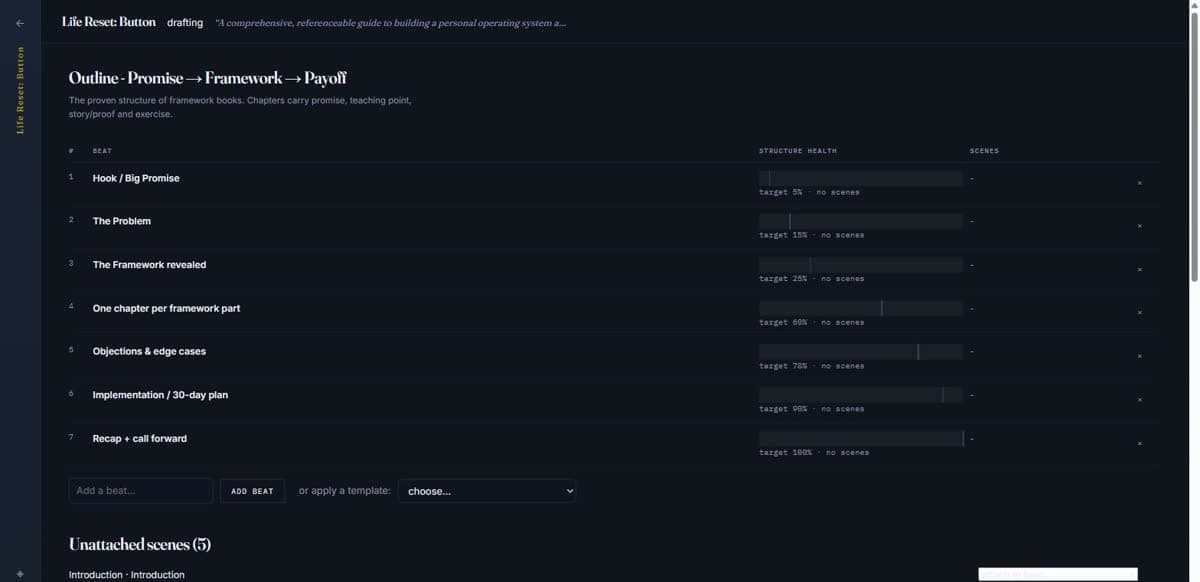
Named frameworks are useful shorthand, but the reader experiences structure as pressure, choice, consequence, and change. A midpoint that appears at exactly fifty percent does not help if it changes nothing; an early midpoint can work if it permanently alters the story.
Novelbound keeps the framework beside scene-level information such as goal, conflict, outcome, and value shift. That lets you evaluate whether a structural moment exists on the page, not only whether a card has the right label.
Save the Cat offers detailed pacing landmarks. The Hero's Journey emphasizes transformation through thresholds and tests. Three-Act / 7-Point gives a lighter skeleton. A custom structure respects books whose design does not fit any of them.
The framework should help you ask better questions: what changes here, what promise is being advanced, and what becomes impossible after this turn? When the answer is clear, a deviation from the template may be a strength rather than an error.
Macro structure fails one scene at a time. A middle sags because scenes repeat a value, a revelation does not change the next decision, or a promise stops developing for too long. Novelbound keeps those local signals visible inside the larger beat map.
During revision, you can move from a structural concern to the exact scene, inspect the characters and threads attached to it, and make a change without losing the surrounding logic of the book.
A practical workflow
Find the moments after which the protagonist cannot return to the earlier version of the story.
Use the framework vocabulary that makes the current story easiest to reason about.
Confirm each important turn produces conflict, consequence, or a meaningful value shift on the page.
Strengthen long stretches without change and make sure the ending pays off the opening promises.
Questions, answered
Novel structure is the ordered pattern of setup, escalation, turning points, choices, consequences, and resolution that gives a story its shape.
There is no single best framework. Choose the lightest model that helps you see the book clearly, then adapt it to the story rather than adapting the story to the label.
Yes. Many discovery writers create the most useful outline after drafting, when the real turning points and gaps are visible.
No. It compares actual and target positions and highlights drift. The writer decides whether the difference needs revision.
Your words stay yours
Bring the book you have, including the messy version.
Start writing with Novelbound